Fujian Aircraft Carrier: Transforming China’s naval Strength
The introduction of the Fujian aircraft carrier represents a significant milestone in China’s military evolution, highlighting President Xi Jinping’s ambitious agenda to broaden and modernize the country’s naval forces.
Revolutionizing China’s Maritime Presence
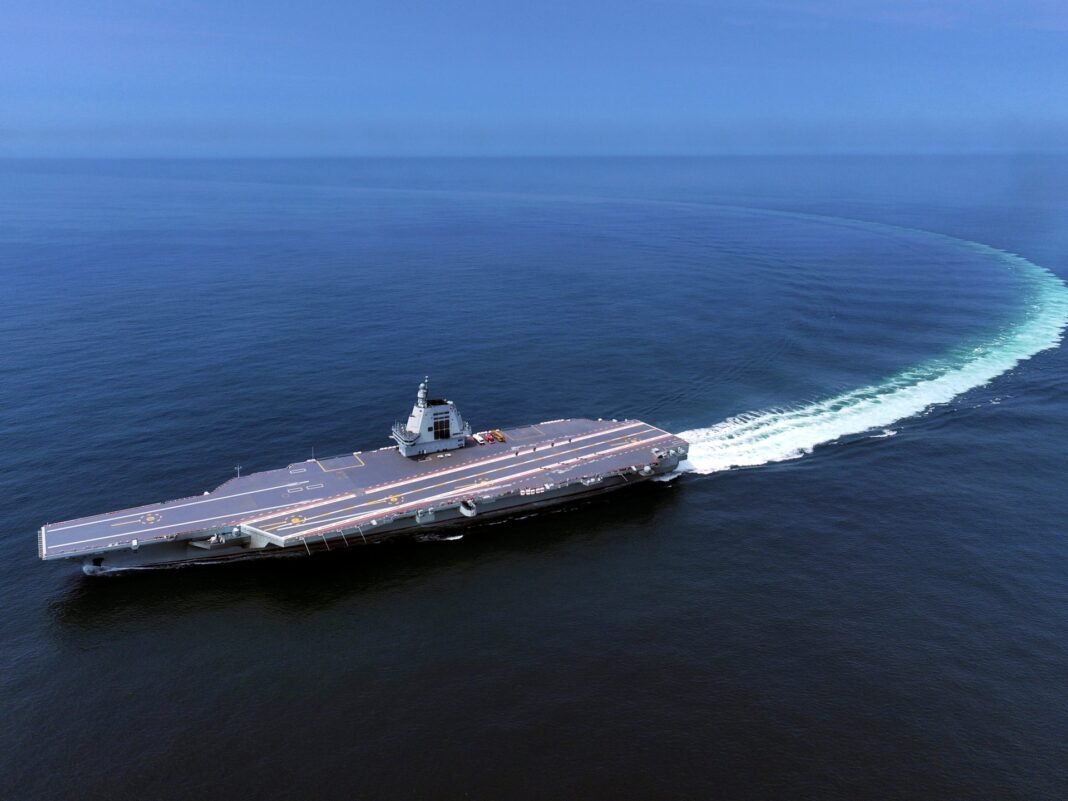
Following extensive sea trials, the Fujian has officially joined China’s active naval fleet. This state-of-the-art carrier is poised to expand Beijing’s operational reach far beyond its coastal waters, bolstering what is already recognized as the world’s largest navy and enhancing its influence throughout the Indo-Pacific theatre.
During an inspection in Sanya on Hainan Island, President Xi emphasized the vessel’s strategic value. Bearing the name of a southeastern province facing Taiwan, Fujian symbolizes China’s intensified maritime ambitions amid escalating regional geopolitical tensions.
Cutting-Edge Design and Enhanced Capabilities
The Fujian distinguishes itself as China’s first aircraft carrier designed and built entirely domestically. Unlike its predecessors-the Liaoning and Shandong-which were adapted from older Soviet blueprints featuring ski-jump ramps for launching aircraft, this new carrier boasts a flat flight deck outfitted with electromagnetic catapult launch systems akin to those on America’s latest Ford-class carriers.
This advanced technology allows for more efficient deployment of heavier fighter jets in greater numbers. Recent sea trials demonstrated successful launches of several complex aircraft including an upgraded J-15 fighter jet variant,a stealth-oriented J-35 tailored specifically for carrier operations,and a KJ-600 early-warning surveillance plane designed to extend situational awareness at sea.
Extended Operational Autonomy at Sea
A major leap forward lies in Fujian’s ability to operate independently over vast oceanic expanses by carrying its own airborne reconnaissance assets. Unlike Liaoning or Shandong-which depend heavily on land-based radar networks-Fujian can conduct prolonged missions without external support, significantly enhancing China’s power projection capabilities well beyond near-shore zones.
The Strategic Role of Aircraft Carriers Within China’s military Ambitions
The timeline for Fujian reaching full combat readiness remains uncertain; however, it stands as one of President Xi Jinping’s most concrete achievements within his complete military modernization plan aimed at establishing global superpower status by mid-century.
xi envisions transforming China’s armed forces into a “world-class” military by 2035 with aspirations to rival U.S. dominance by 2050. The addition of such an advanced platform narrows that gap considerably while signaling Beijing’s commitment toward achieving these long-term goals.
Navigating Complex Regional Power Structures
“Aircraft carriers are pivotal instruments through which Chinese leadership seeks blue-water naval capabilities essential for great power status.”
China aims not only to assert dominance over contested areas within what analysts term the First Island Chain-including waters near Japan, Taiwan, and the Philippines-but also strives for expanded influence across broader Pacific regions traditionally dominated by U.S.naval forces.
While smaller vessels suffice closer to shore due to geographic constraints and proximity to land bases,
carriers like Fujian are indispensable assets enabling Beijing’s navy to challenge American supremacy across vast open ocean spaces stretching deep into Indo-Pacific waters.
A Forward Look at Maritime competition Dynamics
- The First Island Chain: A series of critical maritime chokepoints around East Asia where control shapes regional security;
- Broad Indo-Pacific Arena: An expansive domain where global powers compete using increasingly sophisticated naval platforms;
- Evolving Launch Technologies: electromagnetic catapults represent next-generation systems that improve sortie rates compared with customary steam catapults or ski-jump ramps;
- Missions Beyond coastal Support: Onboard reconnaissance planes empower autonomous long-range operations autonomous from shore-based infrastructure;
An Emerging Force Reshaping Global naval Balance
The commissioning of Fujian marks more than incremental progress-it signals rapid transformation reflecting China’s ambition: evolving from regional dominance toward becoming a formidable blue-water navy capable of sustained worldwide operations that will profoundly influence future maritime security landscapes over coming decades.