decoding the True Identity of Comet 3I/Atlas: Radio Observations Confirm Its Natural Origins
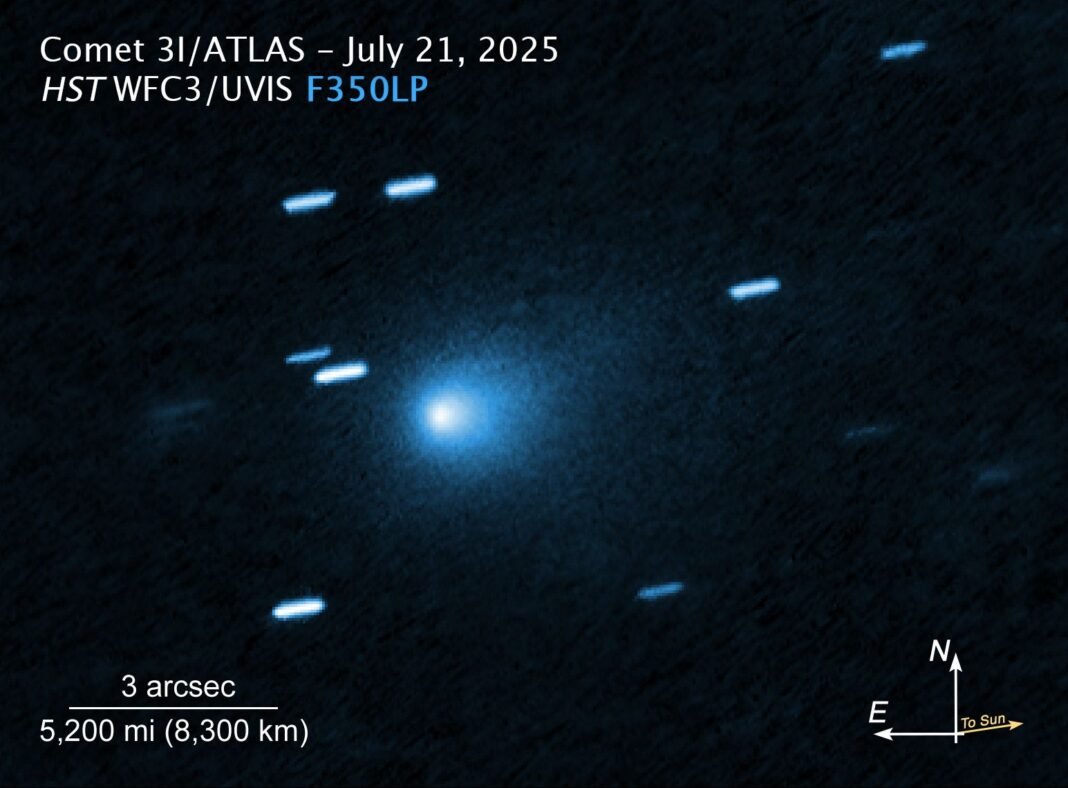
Recent advancements in radio astronomy have decisively affirmed that comet 3I/Atlas is a naturally occurring celestial object, dispelling earlier speculations about it being artificial or technologically engineered. After extensive public debate fueled by social media and podcasts, new findings from a South African observatory have provided robust evidence supporting its classification as a comet.
Radio Astronomy Sheds Light on the Enigma
The key to unraveling this mystery lay in data collected by MeerKAT, an advanced radio telescope array comprising 64 antennas each spanning 13.5 meters. Managed by the South African Radio Astronomy Observatory, MeerKAT identified distinct absorption features at frequencies of 1665 MHz and 1667 MHz, which correspond to hydroxyl (OH) radicals-molecules commonly found in cometary comas.
This revelation should not be mistaken for artificial transmissions or spacecraft signals; rather, these absorption lines are natural signatures produced when OH molecules absorb specific radio waves. Such phenomena are well-known within astrophysical contexts including star-forming regions and interstellar clouds.
The Role of Hydroxyl Radicals in Cometary Spectra
As comets near perihelion-their closest approach to the Sun-solar heat causes sublimation of surface ice into gas. This process releases water vapor that subsequently breaks down into hydroxyl radicals among other fragments. These OH molecules interact with electromagnetic radiation, generating characteristic absorption lines detectable by sensitive instruments like meerkat.
During observations of comet 3I/Atlas near its perihelion phase, conditions favored absorption rather than emission at these spectral frequencies. This behavior aligns with established models explaining how outgassing produces non-gravitational forces affecting comet trajectories.
Sustained Observation and Future Exploration Plans
The accomplished detection on October 24 followed previous unsuccessful attempts earlier that month to capture similar signals from comet 3I/Atlas. Ongoing monitoring is crucial for assessing whether hydroxyl production remains consistent or fluctuates over time while also tracking changes in tail structure to better understand its composition and activity patterns.
A notable figure advocating alternative hypotheses regarding this interstellar visitor’s origin acknowledges that aside from these OH absorption features no other technological radio emissions have been detected so far. Nevertheless, plans include utilizing NASA’s Juno spacecraft during its close approach within approximately 53 million kilometers of Jupiter on March 16, 2026; Juno’s dipole antenna will scan low-frequency bands between 50 hertz and 40 megahertz, searching for any anomalous signals potentially linked to comet 3I/Atlas during this encounter.
The Broader Impact on Scientific Discourse and Public Fascination
This confirmation may not entirely quell all speculative theories surrounding comet 3I/atlas but has undeniably heightened public interest in astrophysics while showcasing how cutting-edge observational technology can clarify cosmic mysteries once clouded by uncertainty.
- A contemporary parallel: Similar observational methods were employed recently when studying ‘Oumuamua-the first confirmed interstellar object passing through our solar system-to explain its unusual acceleration without resorting to extraterrestrial technology theories.
- An up-to-date fact: As of mid-2024, MeerKAT continues enhancing its capabilities as part of global initiatives like the Square Kilometre Array (SKA), poised to revolutionize our understanding of transient astronomical phenomena including interstellar comets entering our solar neighborhood.
- An upcoming opportunity: On December 19, comet 3I/Atlas will reach its closest point relative to Earth this year-offering astronomers and enthusiasts worldwide another chance for direct observation using telescopes or specialized tracking applications designed for such rare events.