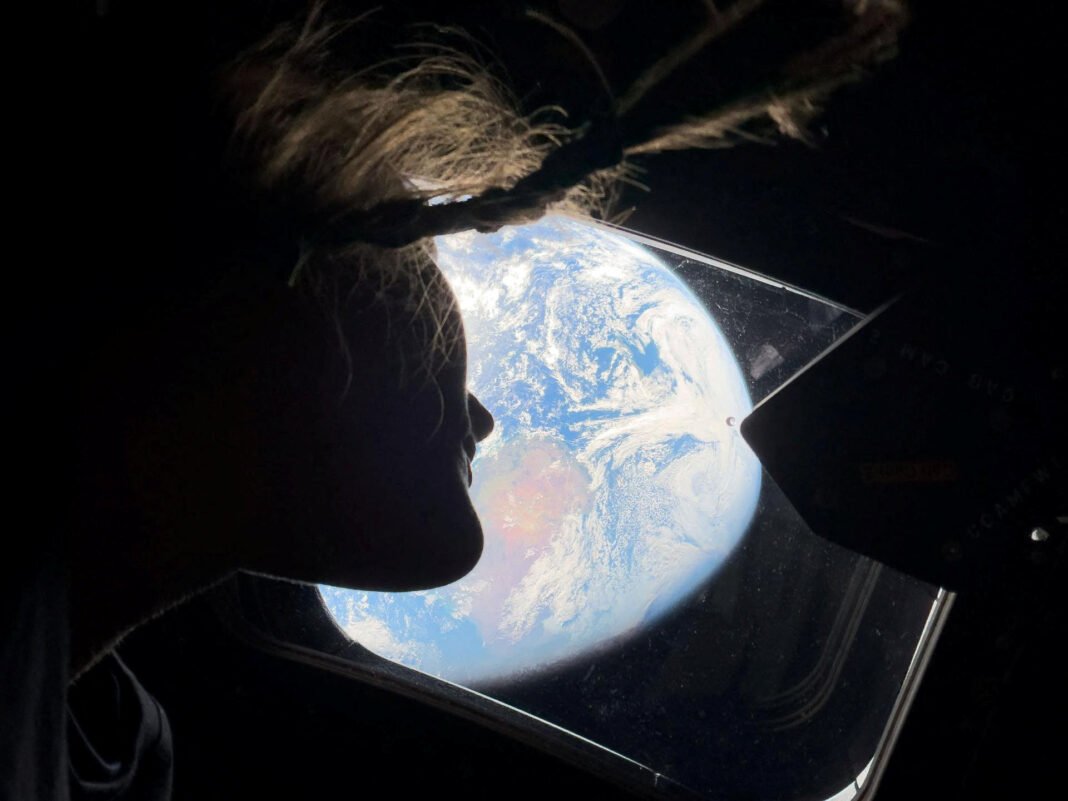
Artemis II Achieves Unprecedented Distance in Human Spaceflight
The four astronauts aboard NASA’s Artemis II mission have set a new record for the farthest distance traveled from Earth by humans, surpassing the milestone established by Apollo 13 in 1970.
Surpassing Apollo 13: A New Benchmark in Space Exploration
At exactly 15:58 GMT on Monday,the Orion spacecraft crew broke through Apollo 13’s long-standing distance record of 400,171 kilometers (248,655 miles) from Earth. This landmark moment marks a significant leap forward nearly six decades after the pioneering Apollo missions first ventured beyond low Earth orbit.
The Artemis II spacecraft is currently executing a trajectory around the Moon’s far side and is projected to reach its maximum distance of about 406,788 kilometers (252,760 miles) from our planet by 23:07 GMT. This achievement highlights critical advancements in human deep space travel technology and mission planning.
Lunar Flyby: Exploring Untouched Terrain
During an extended flyby lasting over six hours, astronauts are conducting detailed observations of lunar surface features. The Orion capsule follows a “free-return trajectory,” which guarantees an automatic return path to Earth within approximately four days after completing their scientific survey.
This mission provides an extraordinary prospect to examine lunar regions rarely seen firsthand by humans.For example, one remarkable image sent back revealed intricate details of the South Pole-Aitken basin-a massive impact crater previously documented only through robotic missions-demonstrating how direct human observation remains invaluable despite sophisticated imaging technologies.
“Human vision continues to outperform any camera system we have or expect to develop soon,” stated Kelsey Young, lead scientist for Artemis II. “The density and adaptability of our eyes offer unparalleled observational capabilities.”
A Diverse crew making History Together
The Artemis II team stands out not just for its scientific objectives but also for its groundbreaking diversity under Commander Reid Wiseman’s leadership. Victor Glover became the first person of color to orbit around the Moon; Christina Koch made history as the first woman on such a journey; and Canadian astronaut Jeremy Hansen marked international cooperation as the first non-American member on this lunar flyby expedition.
Seamless Scientific Coordination with Earth-Based Teams
A specialized group of lunar geologists at NASA’s Johnson Space Center continuously receives live updates from astronauts trained extensively in moon geology and phenomena.Their real-time collaboration ensures that every observation is meticulously recorded to enhance ongoing research during this brief yet crucial period beyond Earth’s immediate communication range.
Managing Communication Blackouts Behind Lunar Horizon
As Artemis II passes behind the Moon-resulting in roughly forty minutes without radio contact due to signal obstruction-Mission control experiences temporary silence.This expected communication blackout reflects common challenges faced when operating near celestial bodies lacking relay satellites positioned beyond them.
A Unique Viewpoint on Our celestial Neighbor
Noah Petro, head of NASA’s planetary geology laboratory, described how astronauts perceive earth’s satellite during close approach: “From their vantage point aboard Orion hundreds of thousands of kilometers away-but still relatively close compared with interplanetary distances-the moon appears about as large as holding a basketball at arm’s length.” This perspective offers vital visual context essential for selecting future landing sites and conducting geological assessments ahead of upcoming missions like Artemis III planned for 2027 and crewed landings under Artemis IV scheduled for 2028.