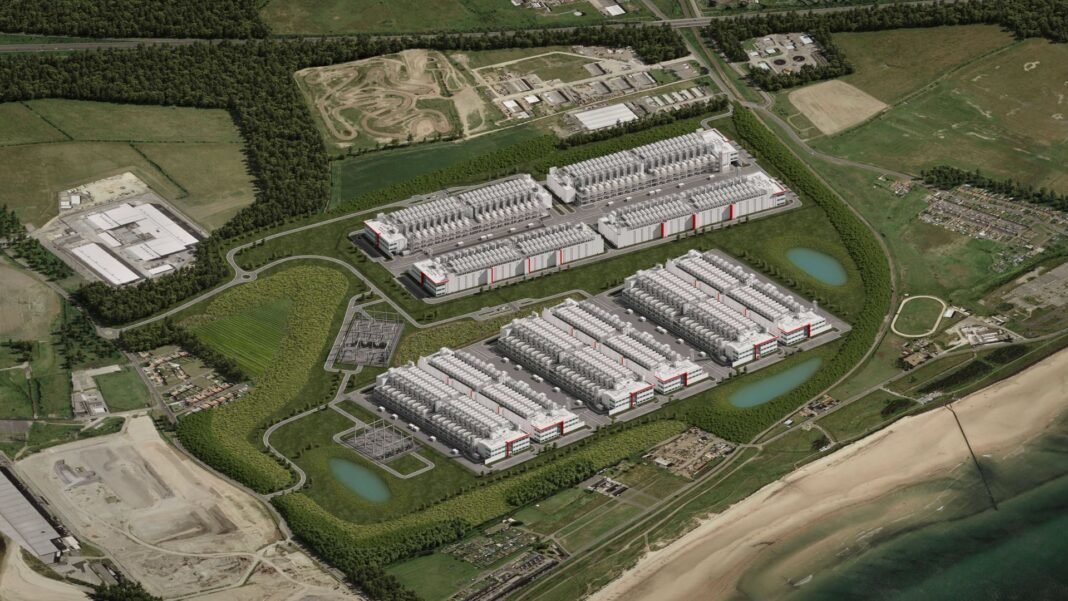
Shaping tomorrow: The U.K.’s Bold Vision for AI Infrastructure Expansion
The United Kingdom is aggressively pursuing a position at the forefront of artificial intelligence innovation by launching a comprehensive AI Opportunities Action Plan. This strategy focuses on embedding advanced AI technologies across various sectors,with a core emphasis on rapidly scaling data center capacity to handle the immense computational power required. These developments are concentrated within specially designated “AI growth zones,” which benefit from expedited planning approvals and prioritized access to energy resources.
Current Landscape and Emerging Hurdles in AI Growth Zones
Since the plan’s inception nearly twelve months ago, leading technology firms such as Nvidia, Microsoft, and Google have committed billions toward building out AI infrastructure nationwide. Four principal growth zones have been identified as hubs for this expansion, where innovative domestic startups like Nscale are playing increasingly vital roles in enhancing local technological expertise.
Nevertheless, significant challenges persist. Energy supply constraints within the national grid and protracted construction schedules threaten to slow progress and undermine the U.K.’s ability to compete globally in this fast-evolving field.
“There remains a disconnect between ambition and execution,” observes Ben Pritchard, CEO of AVK, specialists in data center power solutions. He highlights that “grid congestion has substantially impeded advancement timelines.”
The Complex Reality of Grid Connection Delays
The rollout of these strategic zones is still nascent:
- An Oxfordshire site announced last year remains stuck in planning without any physical construction underway.
- A location in North East England has initiated groundwork but anticipates formal building activities only by early 2026.
- Two recently revealed sites-one each in North Wales (actively seeking investment partners) and South Wales (partially operational)-are advancing at uneven rates.
The government targets these zones collectively supporting over 500 megawatts (MW) of demand by 2030, with ambitions for one zone surpassing one gigawatt (GW). Though, limited grid capacity continues to be a critical bottleneck restricting growth potential.
“Developers face wait times for grid connections ranging from eight up to ten years,” explains Pritchard. He adds that soaring energy demands driven by expanding AI workloads further strain an already overstretched system-delaying or even halting new projects nationwide.
An unexpected outcome has been landowners with existing power lines submitting numerous applications for inclusion within growth zones despite lacking concrete development plans-a trend Spencer Lamb from Kao Data describes as flooding national grid submission processes with speculative requests unlikely to materialize into actual projects.
Navigating Infrastructure Constraints: Strategic Responses Underway
The National Energy System Operator (Neso), tasked with overseeing Britain’s electricity network management, has begun prioritizing hundreds of projects for accelerated grid access. While it is indeed unclear how many specifically target AI infrastructure needs, data centers represent a substantial portion receiving focused attention amid this push forward.
This surge aligns with massive investments from tech giants including Microsoft, Nvidia, Google, OpenAI, and CoreWeave-all dedicating billions toward deploying next-generation chips alongside establishing new data centers across the country. Notably, homegrown startup Nscale aims to deploy tens of thousands of Nvidia GPUs at its london-area facility by early 2027 , underscoring growing domestic innovation capabilities.
Nvidia’s Cutting-Edge Technologies Fueling UK Ambitions

A Comprehensive Strategy: Beyond Mere Hardware installation
Puneet Gupta from NetApp emphasizes that while private sector funding lays essential groundwork, “the real challenge lies in transforming financial commitments into widely accessible compute resources” for organizations throughout Britain.
stuart Abbott from VAST Data stresses that lasting success requires holistic investment-not only hardware but also robust data pipelines, storage infrastructures , renewable energy integration, security protocols ,and nurturing skilled talent pools.
He cautions against viewing this surge as just a temporary spike:
“For lasting impact rather than a fleeting boost,” it is crucial that the UK treats AI infrastructure as essential economic infrastructure.”
The Impact of Energy Costs & Aging Systems on Competitiveness
- The U.K.’s electricity prices remain among Europe’s highest-currently about 75% above pre-conflict levels seen before Russia’s invasion of Ukraine .
- This steep price gap undermines competitiveness relative to countries like Germany or France where diversified supply sources help maintain lower costs.
- Dated electrical grids necessitate lengthy connection lead times before accommodating high-demand facilities such as hyperscale data centers running advanced machine learning workloads.
Sustainable Solutions: microgrids & Smart Location Choices
Pritchard advocates microgrids-localized networks powered through renewables combined with battery storage or backup generators-as practical alternatives when national grid connections prove unavailable or delayed.
AVK currently engineers two such systems supporting cloud computing operations outside direct involvement with artificial intelligence; however, these setups typically require around three years (faster than some traditional connections) but incur approximately 10% higher expenses .
Citing efficiency improvements via co-location strategies where compute facilities leverage existing power infrastructures rather of developing entirely greenfield sites can significantly accelerate deployment timelines according to Abbott.
Kao Data’s Spencer Lamb warns:
“Without rapid resolution on issues spanning energy availability/pricing, AI intellectual property rights, and funding frameworks, the UK risks missing transformative economic opportunities-and may fall behind internationally.”