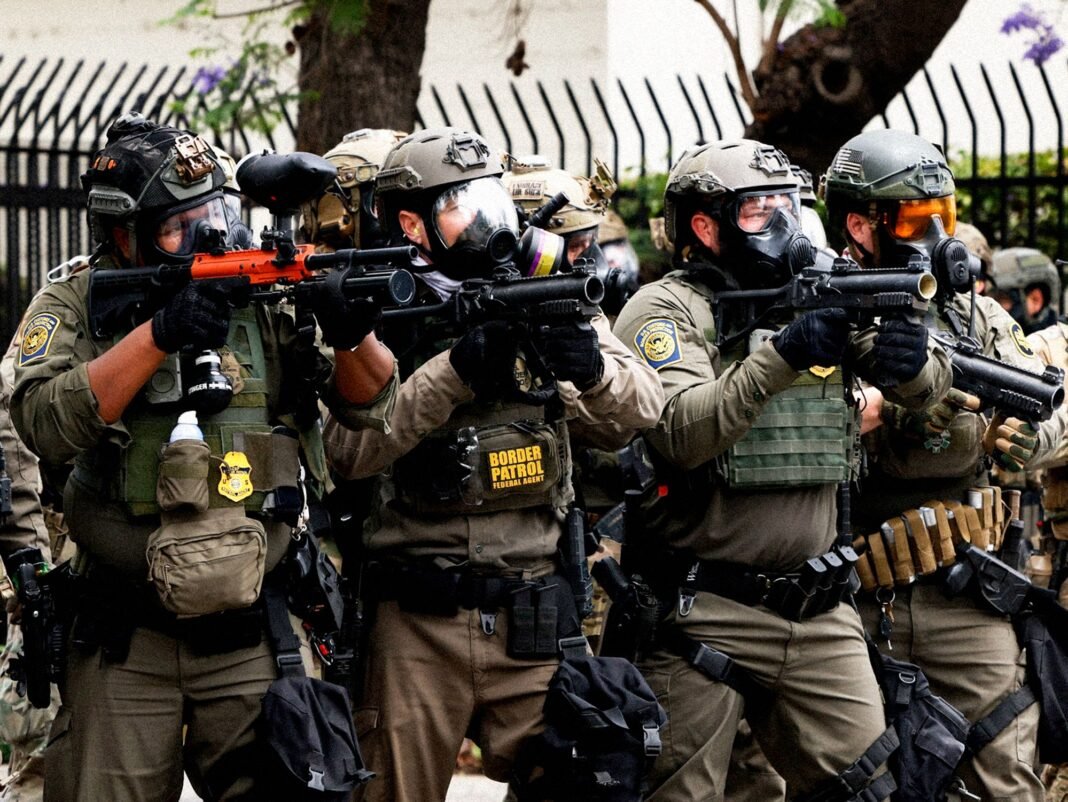
Analyzing the use of “Less Lethal” Weapons in Recent Los Angeles Demonstrations
Over a weekend marked by significant political tension across the United States, law enforcement and National Guard units detained more than 50 protesters in Los Angeles, California. These gatherings began on June 6 as various groups expressed opposition to Immigration and Customs Enforcement (ICE) activities, wich have escalated sharply in recent months. ICE reported an average of over 2,000 arrests daily during early June-more than triple the approximately 660 daily arrests recorded during the first 100 days of donald TrumpS second term.
Heightened Enforcement and Public Backlash
The decision to deploy National Guard forces to control what was essentially a local protest ignited widespread debate. The governor of California criticized this federal intervention as exacerbating tensions rather than alleviating them. Civil rights organizations voiced similar concerns; Amnesty International condemned the militarized response, stressing that armed forces should not be used to intimidate communities or suppress peaceful demonstrations.
Clashes between demonstrators and law enforcement involved personnel from both the National Guard and Los Angeles Sheriff’s Department using so-called “nonlethal” crowd control weapons. These included launchers capable of firing tear gas canisters up to nearly 500 feet away,rubber bullets,stun grenades emitting disorienting flashes and loud noises,fragmentation rounds dispersing rubber pellets upon impact,and paint marker grenades designed for identifying individuals.
Kinetic Impact Devices in Action
Law enforcement employed devices such as the PGL-65 or comparable models like the sage Deuce Projectile launcher (37mm or 40mm caliber), which are common tools within many U.S. police arsenals for riot management. Additionally, reports indicate use of Defense Technology’s green-painted 40mm Single-Shot Launcher (model 1325), specifically adapted for anti-riot purposes-a weapon linked internationally when an Australian journalist was struck by a rubber bullet fired from it while covering protests abroad.

Global Restrictions on “Less Lethal” Weaponry
A number of countries have explicitly prohibited these types of weapons due to their potential for serious harm. Such as, Canada classifies launchers like the PGL-65 as prohibited firearms under its Firearms Regulations (SOR/2020-96). This legislation bans any firearm with bore diameters exceeding 20 mm unless solely intended for bomb disposal-effectively outlawing many kinetic projectile launchers commonly used elsewhere for crowd control.
This ban reflects growing international concern about so-called “less lethal” arms causing severe injuries despite their non-lethal designation.human rights advocates warn that misuse or close-range deployment can result in permanent damage such as skull fractures or blindness.
The Geneva Conventions’ Standards on Kinetic Projectiles
- Kinetic projectiles must never be fired automatically;
- Shooting multiple rounds simultaneously breaches principles requiring necessity and proportionality;
- A complete assessment is essential before deployment to ensure accuracy without excessive force;
- Aim must avoid sensitive areas like face or neck due to high risk of fatal injury.
The conventions emphasize how improper use-especially targeting heads from elevated positions common at protests-increases risks dramatically by potentially causing brain trauma or organ damage if vital body parts are struck at close range.
Lack of transparency Regarding Weapon Models Worldwide
Many governments obscure details about specific models deployed against protesters by categorizing purchases under broad terms such as “40 mm launchers.” This lack of transparency hinders accountability efforts related to misuse or unlawful actions against civilians exercising peaceful assembly rights.
A Latin American Case study: Mexico’s Procurement Practices
In late 2022 Mexico’s secretariat of national Defense initiated procurement requests involving tens of thousands of gas projectiles alongside smoke rounds without revealing manufacturer names or launcher models involved-mirroring regional trends where detailed records remain scarce compared with countries like Canada that maintain explicit registries documenting nonlethal armament acquisitions.
The Real Impact Behind “Less Lethal” Labels
Despite being marketed under terms suggesting reduced lethality compared with traditional firearms, these weapons frequently cause serious injuries documented worldwide amid social unrest:
- An investigation by Chile’s National Human Rights Institute identified over four hundred eye injuries directly linked to police actions since October 2019 demonstrations-with more than thirty victims suffering complete loss or rupture;
- An Amnesty International report titled “My Eye Exploded”, urgently calls for halting usage against peaceful civilians citing numerous cases where impact munitions caused irreversible harm;
- Nations continue struggling with balancing public order maintenance while protecting fundamental human rights amid rising global protest activity-including millions mobilizing recently across Europe demanding climate action where similar crowd-control tactics were extensively deployed throughout early 2024 in cities such as Paris and Berlin.
“Assuming ‘less lethal’ means harmless is dangerously misleading; real-world evidence shows these tools often inflict lasting trauma inconsistent with democratic values.”
Paving Paths Toward Responsible Policing Practices
The surge in ICE-related detentions combined with aggressive policing methods has reignited debates around militarization within domestic law enforcement agencies tasked primarily with community protection rather than battlefield engagement.
This evolving surroundings demands obvious policies governing equipment procurement alongside rigorous training emphasizing de-escalation techniques prioritizing human dignity above suppression through intimidation.
Civic groups advocate phasing out kinetic projectile systems wherever possible while investing instead into dialogue-based conflict resolution frameworks proven effective elsewhere-for example New Zealand’s model focusing heavily on community liaison officers has resulted in considerably fewer violent confrontations despite large-scale demonstrations.