Revealing a New Einstein’s Cross: A Stunning Cosmic Display and dark Matter Insight
According to Einstein’s theory of general relativity, massive celestial bodies such as galaxies distort the fabric of space-time so profoundly that they alter the trajectory of light passing nearby. This phenomenon, known as gravitational lensing, causes light from distant objects to be bent, magnified, and sometimes warped as it travels around these massive entities.
The mechanics Behind an Einstein’s Cross Formation
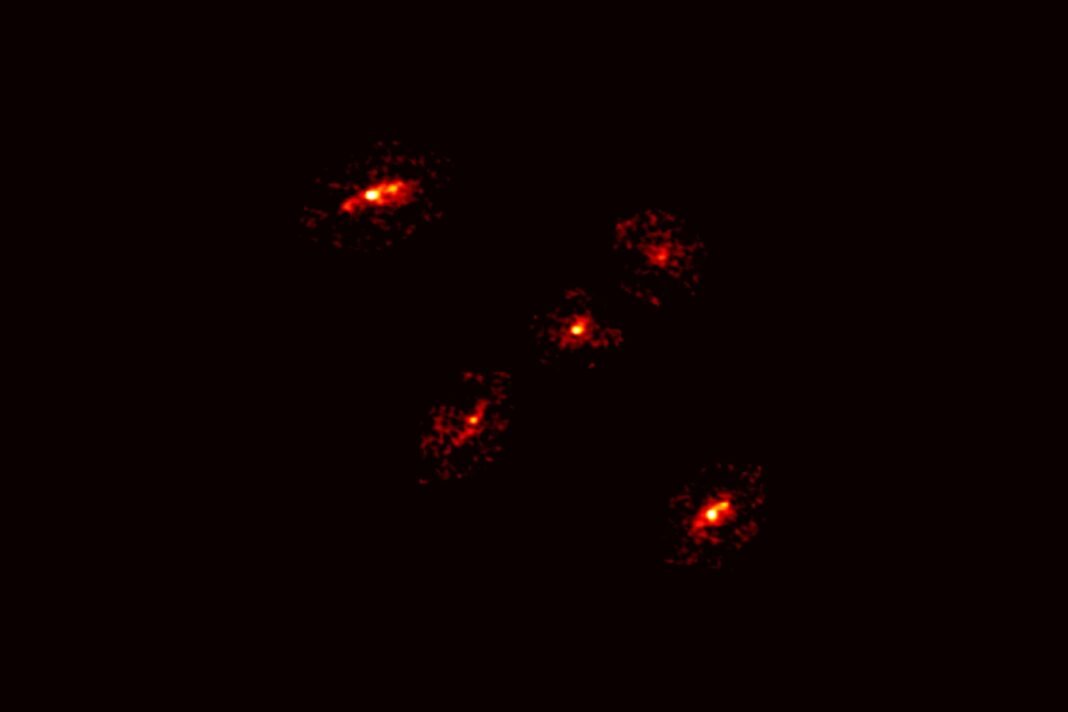
In rare cases, gravitational lensing splits the light from a single distant source into multiple images arranged in a distinctive cross-like pattern called an “Einstein’s cross.” This extraordinary alignment acts like a natural cosmic magnifier, enabling astronomers to observe galaxies billions of light-years away with remarkable clarity and detail.
A Groundbreaking Observation: The HerS-3 Einstein Cross Revelation
Astronomers recently identified a new example of this captivating cosmic event using data from the Atacama Large Millimeter/submillimeter array (ALMA) in Chile. The background galaxy responsible for this newly detected Einstein’s cross is hers-3, situated roughly 11.6 billion light-years from Earth. Positioned between us and HerS-3 are four enormous foreground galaxies about 7.8 billion light-years away; their immense gravitational pull bends and splits HerS-3’s emitted light into multiple images.
This gravitational lensing not only fragments but also amplifies HerS-3’s image, allowing scientists to examine its characteristics in unprecedented detail despite its extreme distance. Observations reveal that HerS-3 is an intensely star-forming galaxy-a luminous starburst-thriving during one of the universe’s most prolific periods for stellar birth. It also exhibits a tilted rotating disk accompanied by powerful gas outflows streaming at extraordinary velocities from its core.
Unlocking cosmic Secrets Through Natural Telescopes
the magnification provided by these natural lenses permits researchers to investigate regions approximately ten times smaller than our Milky Way while looking back nearly 12 billion years in time.Such detailed views offer vital clues about unseen matter along these sightlines and deepen our understanding of early galactic formation processes during the universe’s formative epochs.
The Invisible Architect: Detecting Dark Matter Halos

While initially attributed solely to gravity exerted by these four colossal foreground galaxies, advanced modeling demonstrated their combined mass was insufficient to produce all five observed images comprising the characteristic pattern. To resolve this discrepancy, researchers proposed an additional component-a vast dark matter halo enveloping this galactic group.
This dark matter halo consists predominantly of mysterious particles undetectable through electromagnetic radiation but inferred via their gravitational influence on visible matter and light paths. Current estimates suggest it harbors mass equivalent to several trillion suns clustered together-an immense unseen force sculpting large-scale cosmic structures beyond ordinary detection methods.
The Crucial Role of Dark Matter in Cosmic Evolution
Dark matter remains one of astrophysics’ most profound enigmas; although invisible across all wavelengths accessible with modern instruments, it accounts for approximately 85% of all mass throughout the cosmos based on cosmological observations including those by Planck satellite missions and extensive surveys like DESI (Dark Energy Spectroscopic Instrument). Far more than just scaffolding for visible structures, dark matter governs how galaxies form and evolve over billions of years through its dominant role in shaping gravitational dynamics at grand scales.
The discovery involving HerS-3 opens new avenues for exploring interactions between observable baryonic components-the stars and gas we detect-and underlying dark structures influencing galaxy formation since roughly three billion years after the Big Bang when conditions stabilized enough for complex systems to emerge widely across space-time fabric.