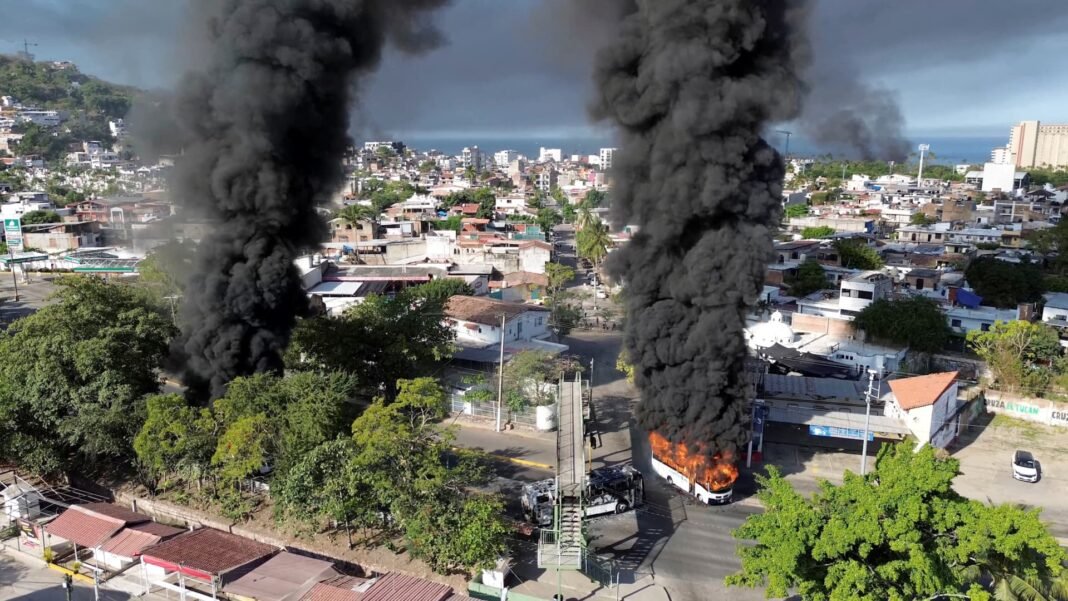
rising Violence in Mexico Disrupts U.S.-Mexico Trade and Freight Networks
Cartel Clashes Trigger Widespread Transport Interruptions Across Mexican Regions
In the aftermath of a military strike that eliminated Nemesio “el Mencho” Oseguera Cervantes, head of the Jalisco New Generation Cartel, violent confrontations have erupted across several Mexican states. Armed factions have resorted to setting vehicles on fire and blocking highways in at least seven states, causing severe interruptions to transportation corridors. The turmoil has been notably acute near Puerto Vallarta in Jalisco.
Air Cargo and Passenger Flight Suspensions compound Supply Chain Strains
The escalation in violence has compelled major U.S. airlines to suspend flights to vital Mexican cities including Guadalajara, Mazatlán, and Puerto Vallarta. As nearly 50% of air freight by weight is carried aboard passenger planes, these flight cancellations are considerably impeding cargo transit between Mexico and the United States.
- American airlines, Southwest Airlines, Delta Air Lines, United Airlines, and Air Canada have all either canceled or rerouted flights due to safety concerns.
- The disruption affects not only passenger services but also freighter operations at key airports such as Guadalajara, where delays or cancellations are increasingly common.
- A logistics representative from Kuehne + Nagel noted that while major hubs like Felipe Angeles Airport and Mexico City Airport remain functional for now,last-mile delivery into affected areas faces growing challenges.
Diminished Trucking Capacity Along Critical Border Routes Intensifies Pressure on Freight Movement
The ongoing unrest is placing considerable strain on trucking corridors linking Mexico with the United States.Typically over 20,000 commercial trucks cross daily between Laredo (Texas) and nuevo Laredo (Mexico), yet many carriers are now hesitant to send drivers into unstable western regions due to security threats.
This reluctance has rapidly shrunk available trucking capacity near border crossings such as Laredo and El Paso. Industry experts highlight several consequences:
- Tightened capacity prompts shippers to accelerate shipments while carriers become more selective about loads;
- This supply-demand imbalance drives up spot market rates for trucking services;
- Dwell times for trucks waiting at border checkpoints are increasing;
- If instability continues unchecked, cross-border freight flows could face severe bottlenecks given limited infrastructure versatility.
A Comparable Incident: The 2023 Canadian Truckers’ Protests Impacting North American trade Routes
This scenario echoes disruptions witnessed during the 2023 Canadian trucker protests when blockades caused critically important delays along key trade arteries between Canada and the United States-demonstrating how political or security crises can swiftly ripple through international supply chains.
Main Container Port Operations Face Interruptions Amid Security Threats
The Port of Manzanillo-Mexico’s busiest container port handling over 4 million TEUs annually-was temporarily closed following cartel-related blockades. Even though operations resumed shortly after:
- Persistent fires along access roads continue hampering cargo movement;
- This port serves as a crucial entry point for Asian imports destined for North America;
- DHL reports reduced volumes not only from Manzanillo but also other major ports like Lázaro Cárdenas and Veracruz amid ongoing unrest;
- Kuehne + Nagel confirms logistical difficulties with container pickup/drop-off processes directly linked to these disturbances.
Crisis Response Measures Amid Heightened Uncertainty
The U.S. State department has issued shelter-in-place advisories covering multiple affected states including Jalisco (home to Guadalajara),Tamaulipas (including Reynosa),Michoacán,Guerrero,and Nuevo León due to escalating violence threatening public safety.
In response:
- Certain logistics companies have transitioned employees within high-risk zones toward remote work arrangements;
- Complex contingency plans involving shipment rerouting where possible are being implemented;
- Bottlenecks persist given highway closures near critical border crossings such as El Paso.
Navigating Delays: Strategic Advice for Shippers
“Expect freight moving through western Mexico to encounter delays lasting at least through midweek,” advises Veronica Gonzalez from CH Robinson based on extensive experience managing regional crisis impacts on supply chains.
The Economic Imperative: Stability’s Role in Sustaining North American Trade
México remains one of the top three trading partners of the United States with bilateral trade surpassing $700 billion annually as of early 2026. Disruptions along essential transport routes threaten not only timely deliveries but also risk inflating costs across sectors reliant on just-in-time inventory systems-from automotive manufacturing centers in Michigan dependent on parts crossing Texas ports-of-entry-to agricultural exports moving south via rail lines traversing northern Mexican states.
The recent surge in cartel-related violence exposes vulnerabilities within this tightly integrated economic network where security incidents can cascade into widespread logistical paralysis affecting millions downstream globally.
Following El Mencho’s death-a figure whose influence permeated narcotics trafficking networks-the resilience shown by freight operators will be tested further amid evolving threats requiring agile strategies balancing safety with commerce continuity.