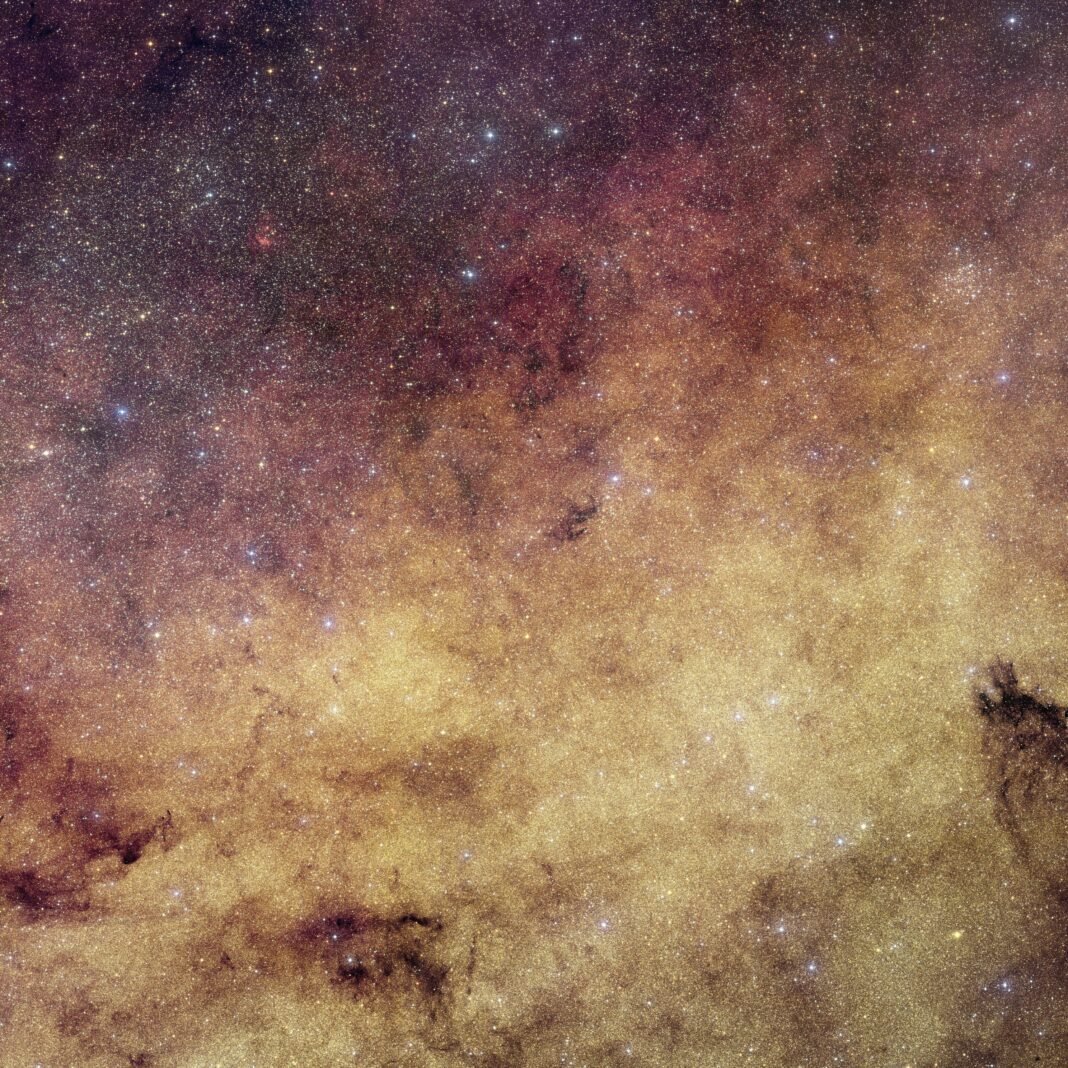
Euclid Telescope Reveals Unmatched Panorama of the Milky way’s central Region
The European Space Agency’s Euclid telescope has captured the most extensive and detailed visible-light image ever taken of the Milky way’s galactic bulge, the densely populated core of our galaxy. This remarkable mosaic showcases over 60 million stars, along with nebulae and star clusters, providing astronomers with an invaluable dataset to enhance exoplanet detection through gravitational microlensing techniques.
Transforming Galactic imaging with Euclid’s Capabilities
Although primarily designed to investigate billions of distant galaxies, Euclid’s visible-light camera boasts extraordinary sensitivity that enables it to resolve individual stars within the intensely bright and crowded center of our galaxy. Unlike many instruments overwhelmed by such brightness, Euclid distinguishes these stars with remarkable clarity.
In a rapid observational session lasting only 26 hours on March 23, 2025, Euclid compiled this vast image from nine exposures-each covering a sky area larger than that occupied by the full moon. This swift data acquisition highlights its advanced technological prowess.
while telescopes like Hubble provide comparable resolution in visible light, Euclid outperforms them significantly in field coverage: each pointing spans roughly 270 times more sky area than Hubble’s view.To put this into viewpoint, ground-based observatories such as Subaru would require nearly two thousand hours to assemble a similar mosaic at equivalent depth and detail.
A Comprehensive Stellar Inventory at Our Galaxy’s Core
This new composite captures one of the densest stellar environments known-the galactic bulge-where star crowding creates optimal conditions for detecting exoplanets via gravitational microlensing. This phenomenon occurs when a foreground star passes in front of a background star and magnifies its light due to gravity bending space-time.
The high density near the galactic center increases opportunities for such lensing events; historically earth-based surveys targeting this region have discovered close to 300 exoplanets using microlensing alone. Embedded within this latest image are data on at least 51 previously confirmed planetary systems alongside numerous other potential candidates awaiting confirmation.
Gravitational Microlensing: Unlocking Hidden Planetary Systems
This method depends on tracking subtle fluctuations in brightness caused by lensing effects as planets orbit their host stars. Although identifying new microlensing events requires continuous monitoring over several weeks-a timeframe longer than Euclid’s brief campaign-the telescope’s snapshot provides essential baseline information critical for future detections and analyses.
Setting New Standards for Exoplanet Mass Determination
A notable benefit from these observations lies in establishing temporal reference points ahead of upcoming missions like NASA’s Nancy Grace Roman Space Telescope scheduled for launch later this year. By documenting how stars appeared before alignment during future microlensing events detected by Roman or other observatories, researchers can calculate planetary masses more precisely and improve models describing their physical properties.
“Euclid has effectively created an archive capturing pre-event images across all anticipated microlensing occurrences expected from Roman,” project scientists noted regarding their analysis efforts. This archival role will refine mass measurements and deepen insights into planetary systems beyond our solar neighborhood.”
Broad Scientific Horizons Beyond Exoplanet Revelation
The high-resolution imagery also facilitates studies into brown dwarfs-objects straddling planets and stars-as well as binary star interactions, stellar kinematics within our galaxy’s core region, and mapping interstellar dust distributions that influence galactic evolution processes.
An Exciting New Chapter in Galactic Research Unfolds
With just one day devoted to imaging the Milky Way’s heart, Euclid has delivered unprecedented data richness combined with expansive spatial coverage-opening fresh avenues across multiple astrophysical fields while maintaining exceptional detail quality previously unattainable at such scales.