New Insights from Rediscovered megalodon Vertebrae Illuminate Ancient Ocean Giant
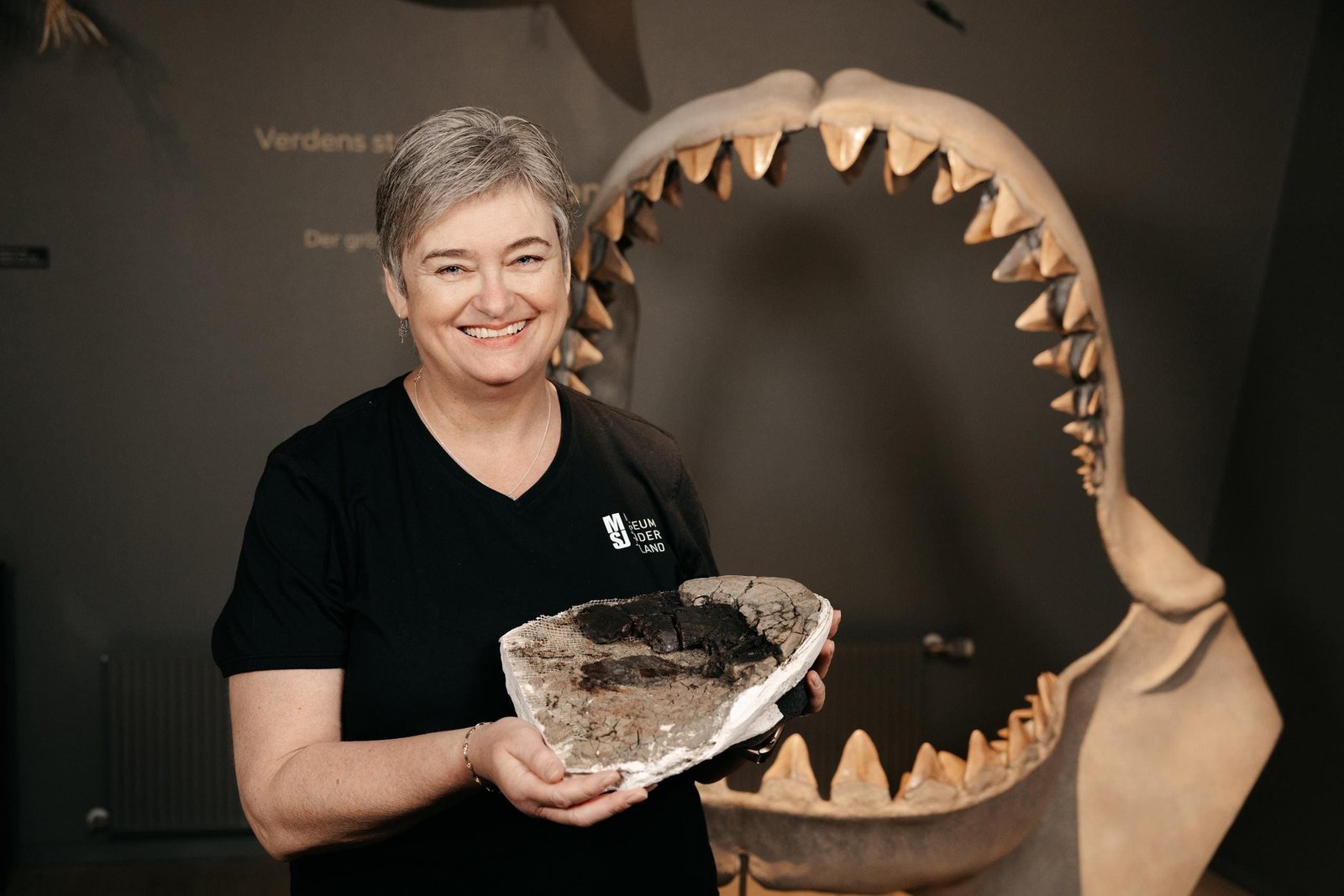
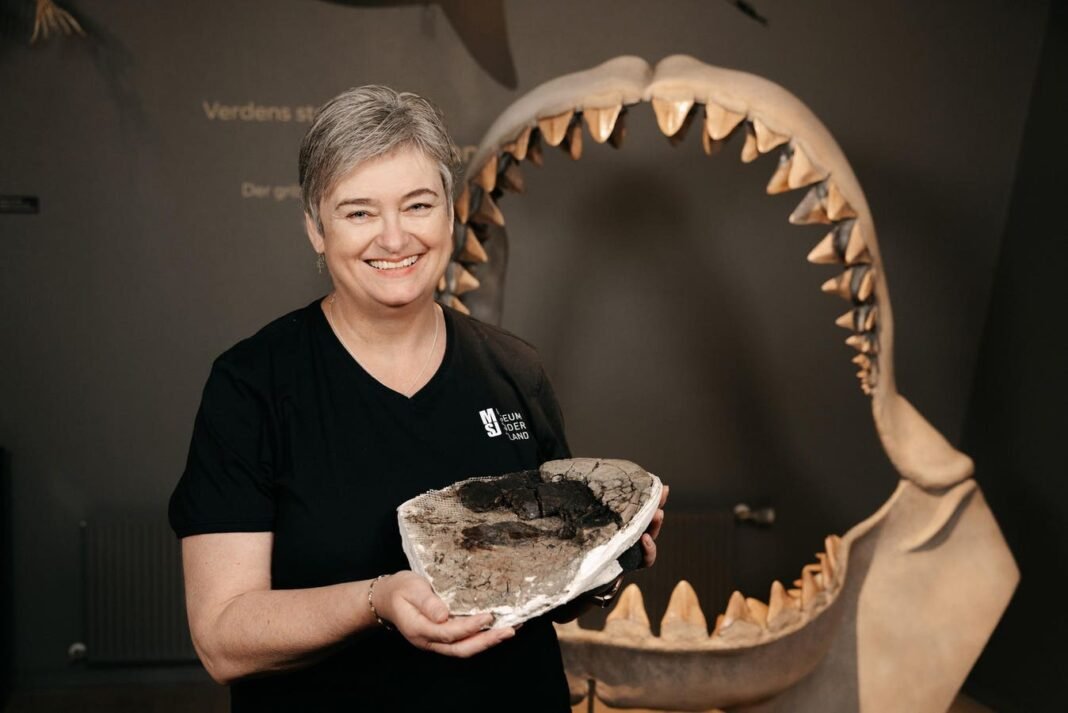
Dr. Mette Elstrup presenting a vertebral fossil dating back approximately 10.8 million years, belonging to the extinct megatooth shark Otodus megalodon, discovered in Denmark’s Gram Formation; a reconstructed jaw model is displayed behind.
Museum of Southern Jutland, Gram, Denmark
Unearthing Forgotten Fossils: A Journey Back to the Miocene Seas
In the late 1970s, clay mining operations in southern Denmark revealed enormous vertebrae fossils attributed to the legendary megatooth shark known scientifically as Otodus megalodon.At that time, these bones were among the largest shark vertebrae ever documented worldwide. Regrettably, during museum relocations in subsequent decades, these priceless specimens disappeared from public and scientific view-assumed lost indefinitely.
Recently rediscovered within neglected storage compartments of museum archives, these fossils have resurfaced to shed new light on one of history’s most formidable marine predators. Their recovery not only resolves long-standing questions about their whereabouts but also provides valuable data on Megalodon’s potential size range, lifespan estimates, and feeding habits.
The Vast World of Megalodon: Myth Versus Science
Megalodon inhabited Earth’s oceans roughly between 15 million and 3.6 million years ago during the Miocene and Pliocene epochs. This prehistoric giant has captured popular imagination through films and documentaries as an apex predator far surpassing modern sharks in scale and power.
Despite its cultural prominence however, scientific understanding remains limited due to sharks’ cartilaginous skeletons rarely fossilizing well compared to bony fish. Most knowledge derives primarily from massive teeth-some exceeding seven inches (18 centimeters) long-while complete skeletal remains are exceedingly rare for this species.
The Significance of Vertebral Fossils for Paleobiology
This scarcity makes every recovered vertebra or fragment invaluable for researchers aiming to reconstruct aspects of Megalodon’s biology beyond tooth morphology alone.
The newly found fossils come from Denmark’s Upper Miocene Gram Formation-a marine sedimentary layer formed around 10.8 million years ago when deep offshore seas covered present-day southern Jutland at depths exceeding 100 meters (328 feet).
- This ancient habitat supported diverse marine fauna including various sharks like Megalodon itself; rays; numerous fish species; early whales and dolphins; seabirds; plus sea turtles-all evidenced by abundant fossils at this site.
- The Danish specimen originally contained about twenty vertebrae; although some have deteriorated over time,
a notable number remain sufficiently preserved for detailed study. - Certain individual vertebrae measure up to nine inches (23 centimeters) across-the largest diameter recorded among any known fish bones globally.
Sizing Up a Titan: how Large Did This Shark Grow?
Paleobiologist Kenshu Shimada conducted comparative analyses matching these colossal Danish vertebrae with more complete specimens found elsewhere-including belgium-and applied proportional scaling based on living relatives such as great white sharks alongside extinct kin to estimate total body length accurately.
“The rediscovery confirmed earlier reports showing maximum vertebral diameters reaching twenty-three centimeters,” said Shimada.
“This specimen likely represents not only record-breaking shark bones but possibly those belonging to any fish ever documented.”
The latest reconstructions suggest this individual coudl have reached nearly eighty feet (24.3 meters) long-almost three times larger than today’s great white sharks-and longer than many city buses commonly seen worldwide!
Navigating Uncertainties: Interpreting Size Estimates Carefully
- Total length approximations rely heavily on assumptions that anatomical proportions between extinct species align closely with modern analogues;
- Lack of full skeletal context means growth rates must be inferred indirectly through comparisons;
- No conclusive evidence yet confirms whether individuals regularly attained or exceeded such sizes across global populations during Miocene times;
- “While theoretical models allow slightly larger sizes,” Shimada emphasizes, “24.3 meters currently stands as our best scientifically supported maximum estimate.”
Aging Giants: Micro-CT Scanning Reveals Lifespan Clues
The research team utilized cutting-edge micro-computed tomography scanning technology enabling non-invasive internal examination that uncovered growth rings inside each bone-conceptually similar to counting tree rings-to estimate age at death precisely.
- A minimum count identified sixty-four distinct growth bands indicating an age surpassing sixty years;
- Theoretical extrapolation suggests lifespans approaching ninety-six years might have been possible under optimal environmental conditions;
- This longevity aligns with slow maturation rates observed in today’s apex predators such as large whales or Greenland sharks renowned for extraordinary lifespans;
An Unexpected Dietary Hint Found Within Surrounding Sediments: Evidence From Prey Remains?
An intriguing discovery emerged upon analyzing sediments encasing these massive bones-a presence of microscopic scales along with gill-related structures identified as belonging not to another predator but rather a basking shark (Cetorhinus maximus).
- Basking sharks are gentle giants feeding primarily via filter-feeding plankton consumption yet can grow impressively large themselves-sometimes exceeding thirty feet (~9 meters); however their anatomy differs markedly especially regarding skeletal proportions compared with predatory megatooth sharks;
- This anatomical mismatch rules out misidentification suggesting instead that basking shark remains may represent stomach contents preserved alongside Megalodon’s own fossilized material;
- If confirmed true,this would constitute direct evidence linking prey items consumed by one of Earth’s largest prehistoric predators-a connection previously unknown until now;
- Sheds light on dietary breadth implying opportunistic hunting or scavenging behaviors targeting sizeable marine fauna beyond just whales or seals often hypothesized before.
Megalodon’s ecological role likely encompassed diverse trophic interactions within its ancient oceanic ecosystem.
Megalodon’s Lasting Mysteries And Its Role In Modern Science
Megalodon’s story continues evolving even decades after initial discoveries because basic questions remain unanswered:
Megalodon’s maximum size range still fuels debate among scientists while its precise growth patterns remain elusive without more extensive global fossil records.
Until more complete skeletons emerge providing definitive insights into anatomical variations across regions and epochs,the rediscovered Danish specimens stand out prominently offering some of our strongest empirical evidence supporting claims it was truly among Earth’s largest oceanic hunters ever recorded.
These revelations continue sparking fascination about prehistoric oceans reminding us how much remains hidden beneath waters covering over two-thirds of our planet’s surface.