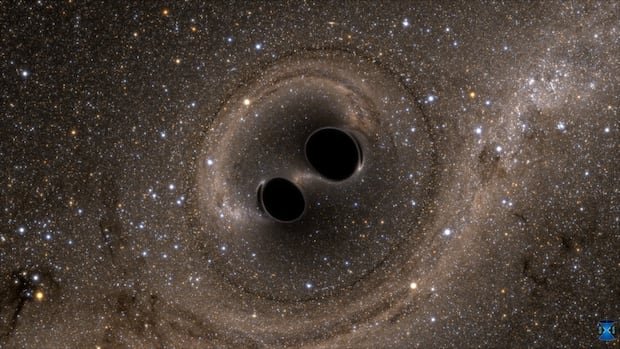
Breaking New Ground: The Largest Black Hole Merger Ever Recorded
A groundbreaking cosmic collision has been observed, where two massive black holes merged to create a single black hole with a mass exceeding 225 times that of our sun. This extraordinary event challenges existing astrophysical theories and opens new avenues for understanding the universe’s most enigmatic objects.
The Phenomenon Behind the Colossal Collision
On November 23, 2023, gravitational wave detectors around the globe captured signals from an unprecedented merger involving black holes weighing roughly 100 and 140 solar masses. These titanic bodies combined to form a newly minted black hole surpassing 225 solar masses-far larger than typical mergers previously recorded, which usually involve black holes between 10 and 40 times the sun’s mass.
This event, labeled GW231123, is remarkable not only for its sheer scale but also as both original black holes were spinning near their theoretical maximum speeds as predicted by Einstein’s general relativity. Such rapid rotation adds complexity to modeling these phenomena but provides invaluable data for refining gravitational wave analysis techniques.
Gravitational Waves: The Universe’s Subtle Vibrations
Gravitational waves are minute ripples in spacetime generated by accelerating massive objects like merging black holes or neutron stars. Since their initial detection in 2015-nearly a century after Einstein first theorized them-over 300 such events have been documented worldwide using advanced observatories located across the united States, Japan, and Italy.
The recent discovery pushes observational boundaries further by revealing mergers involving exceptionally large and fast-spinning progenitors that were previously thoght rare or challenging to detect.
Diverse Classes of Black Holes Across Cosmic Scales
- Supermassive Black Holes: Found at galaxy centers with masses ranging from millions up to billions of suns; for example, Sagittarius A* at our Milky Way’s core weighs about four million solar masses.
- Stellar-Mass Black Holes: Created when massive stars collapse after supernova explosions; typically between a few and several tens of solar masses but occasionally reaching hundreds under unique conditions such as dense stellar environments or prior mergers.
- Intermediate-Mass Black Holes: Bridging the gap between stellar-mass and supermassive varieties (hundreds to thousands of solar masses), these elusive entities remain challenging to confirm definitively despite mounting indirect evidence from X-ray observations and star cluster dynamics.
A contemporary Example From Our Galactic Neighborhood

Puzzling Origins: How Do Such Massive Progenitors Form?
The immense size of these merging black holes raises intriguing questions about their formation pathways since conventional stellar evolution struggles to produce remnants this heavy directly. One leading theory proposes that each was itself born from earlier collisions among smaller black holes-a cascading sequence building ever-larger bodies over cosmic time scales.
An Alternative Growth Scenario within Star Clusters
An additional hypothesis involves rapid mass accumulation through accretion inside dense star clusters rich in gas. In this environment, smaller seed black holes-initially just one or ten times the sun’s mass-could efficiently consume surrounding matter much like voracious celestial predators. This mechanism might allow them to grow into intermediate-mass scales even billions of years after the universe’s early epochs when gas was more abundant than today’s sparse interstellar medium.

The Meaning Beyond Science: Humanity’s Place Among Stars
“As ancient times humans have looked skyward with awe at celestial transformations-from eclipses illuminating night skies to distant supernovae marking cosmic death throes-the quest for understanding our place within this vast cosmos remains deeply rooted.”
This discovery enriches not only scientific knowledge but also humanity’s enduring curiosity about existence amid an immense universe filled with dynamic processes far beyond everyday perception.Pinpointing where such colossal mergers occur remains challenging; current estimates place GW231123 anywhere between two billion and thirteen billion light-years away-a testament both to technological prowess and mysteries still awaiting exploration.
The future Trajectory for astrophysics Research
- Enhancing localization techniques will improve identification of host galaxies or environments;
- Diving deeper into spin behavior could reveal clues about formation histories;
- Developing theoretical models capable of handling extreme parameters will boost interpretation accuracy;
- Larger datasets expected over coming years promise richer insights into population statistics across cosmic epochs;
- This landmark event exemplifies how cutting-edge observations continue reshaping essential concepts regarding growth mechanisms governing massive structures throughout space-time history.