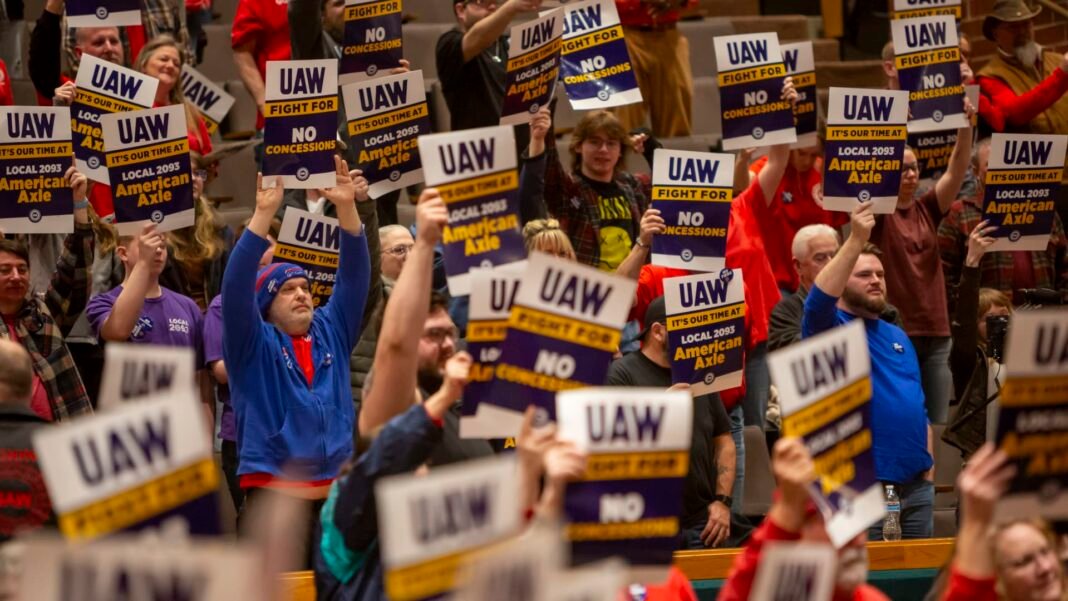
UAW Members Launch Strike at Michigan Supplier Over Pay Disagreements
In Three Rivers, Michigan, close to 1,000 workers at a crucial supplier plant responsible for manufacturing parts used in General Motors pickup trucks began striking early Monday after contract negotiations with Dauch Corp. reached an impasse.
Origins and Details of the Labor Conflict
The United Auto Workers (UAW) union confirmed that employees at the axle and components facility-previously known as American Axle and Manufacturing-stopped working exactly at midnight Eastern Time. This strike represents a meaningful intensification in ongoing talks aimed at securing improved wages and benefits.
Although the union has withheld full disclosure of all demands, it stressed that workers are seeking to recoup earnings lost during the 2008 financial crisis. According to UAW officials, long-serving employees who once earned up to $29 per hour saw their pay slashed by nearly half during that downturn, dropping to approximately $14.50 hourly. Presently, top wages hover around $22 per hour after several years on the job.
Voices from Union Leadership and Workforce Perspectives
“Our strike will continue until this company acknowledges what fairness truly means,” asserted UAW President Shawn Fain in a recent nationwide video address. “The full power of our international union supports these members-no contract means no axles.”
Jon Krause, a veteran employee with over 30 years’ experience at American Axle and member of UAW Local 2093’s bargaining team representing those on strike, emphasized additional concerns beyond salary hikes: better healthcare plans, enhanced retirement benefits, and safer workplace conditions.
“our members deserve compensation that reflects their dedication,” Krause remarked. “When this company faced tough times nearly twenty years ago, our local helped sustain it; now they must honor that commitment.”
Dauch Corp.’s Position and Industry-Wide Implications
A spokesperson for Dauch Corp. described the walkout as “disheartening” but reaffirmed their intention to engage constructively toward reaching a fair agreement promptly.
“We believe meaningful progress comes through open dialogue around the negotiation table,” stated the company representative. “Our objective remains achieving outcomes beneficial for employees, management teams, and stakeholders alike.”
The Three Rivers facility produces axles vital for GM’s Chevrolet Colorado and GMC Canyon midsize pickups and also heavy-duty Chevrolet Silverado and GMC Sierra models. It also manufactures smaller components integrated into GM’s light-duty Silverado/Sierra trucks along with parts used in Stellantis’ Chrysler Pacifica minivan.
Automakers Closely Watching Developments
A general Motors official confirmed active monitoring of events but reported no immediate production disruptions across their plants as of Monday morning. Industry analysts estimate GM currently maintains roughly two weeks’ supply of axles from this supplier.
A Stellantis representative shared similar views: “We are closely observing the situation but do not foresee any production interruptions currently.”
The Larger Picture: Labor Actions amid Supply chain Pressures
This labor stoppage mirrors wider patterns within manufacturing sectors where workforces demand fairer pay amid inflationary pressures squeezing household budgets-the US Bureau of Labor Statistics recently recorded consumer prices rising over 5% year-over-year through early 2026.
- The automotive sector has experienced numerous labor disruptions lately; last year alone saw major strikes affecting assembly plants across North America causing temporary shutdowns costing millions daily.
- This dispute highlights friction between legacy suppliers adjusting post-recession wage frameworks versus skilled workers pushing for compensation aligned with today’s economic realities.
- An analogous example can be found in recent semiconductor factory strikes where employees demanded hazard pay due to increased workloads amid global chip shortages impacting electronics markets-a reminder that supply chain stability frequently enough depends on workforce contentment.
- If unresolved swiftly here or elsewhere along critical supply chains supporting automakers like GM or Stellantis-which together produce millions of vehicles annually-there could be cascading delays affecting vehicle deliveries or cost increases passed onto consumers worldwide.
- This scenario underscores how essential labor relations remain not only locally but globally within complex manufacturing networks driving modern transportation industries forward amidst rapid shifts toward electrification and automation reshaping employment landscapes entirely.