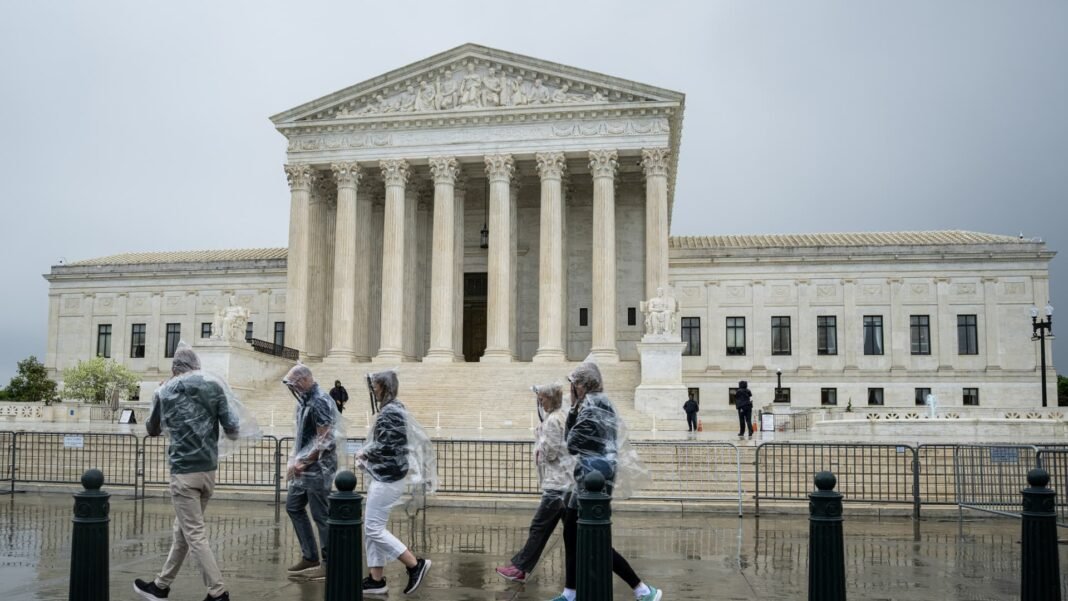
Supreme Court Clears Path for Alabama GOP’s Controversial Congressional Redistricting
High Court Reverses Lower Court, Allowing New Voting Map to Proceed
The U.S. Supreme court has overturned a lower court injunction, permitting Alabama Republicans to implement a new congressional district map that opponents argue suppresses the voting power of Black citizens. This ruling removes previous legal barriers that had halted the plan due to allegations of racial discrimination in electoral boundaries.
Consequences for Minority Representation and Political Dynamics
The newly approved map decreases the number of districts where Black voters hold majority or near-majority status from two down to just one out of seven congressional seats in Alabama. Since Black voters predominantly support Democratic candidates, this redistricting is expected to bolster Republican chances in forthcoming elections.
Historical Context: Voting Rights Act and Judicial Shifts
This decision comes amid ongoing erosion of key protections under the Voting Rights Act, which historically ensured minority communities could elect candidates reflecting their interests. In April 2026, the Supreme court invalidated Louisiana’s electoral map for overemphasizing race when drawing two Black-majority districts, citing constitutional equal protection concerns as justification.
Alabama’s Legal Strategy Following recent Rulings
In response to these developments, Alabama quickly petitioned the Supreme Court for emergency relief to reinstate an older district configuration featuring only one majority-Black district instead of two. State officials contended that their revised plan shared constitutional issues similar to those identified in Louisiana’s case but argued it was necessary under current legal standards.
Dissent Highlights Risks of diluting Minority Votes
Liberal justices voiced strong opposition against overturning protections designed to preserve minority representation in Alabama’s districts. Justice Sonia Sotomayor underscored that unlike Louisiana’s situation, evidence showed intentional vote dilution targeting Black residents-a violation under both federal law and constitutional guarantees.
“Removing these safeguards threatens voter clarity mere days before elections,” Sotomayor cautioned in her dissent joined by fellow liberal members.
The National Landscape: Intensifying Redistricting Conflicts Across States
The decennial redrawing of legislative boundaries based on census data has become increasingly fraught with partisan disputes nationwide. As 2023,Republican-led states have aggressively pursued mid-decade redistricting efforts beyond traditional timelines-aimed at consolidating political advantage not only in Texas but now also Alabama and other battlegrounds.
- This surge reflects heightened competition ahead of critical midterm elections scheduled for November 2026 as parties vie for control over Congress.
- A recent analysis revealed nearly 40% of U.S. states faced major redistricting controversies between 2020 and 2024-highlighting how electoral maps remain pivotal arenas for political power struggles.
- Tactics such as “packing” (concentrating opposition voters into few districts) and “cracking” (diluting them across many) continue undermining minority communities’ ability to elect representatives aligned with their interests.
Demographic Insights: the stakes for Alabama’s Electorate
African Americans make up roughly 27% of eligible voters in Alabama-a significant demographic whose collective influence has been safeguarded through majority-minority districts until now. The reduction from two such districts threatens not only equitable political representation but also broader civic engagement within southern states sharing similar population profiles.
Future Implications: What Voters Should Expect Moving Forward
This Supreme Court ruling establishes a precedent likely encouraging other Republican-controlled states to pursue comparable changes amid diminished federal oversight following adjustments weakening the Voting Rights Act protections. As election day nears rapidly, Alabamians face uncertainty about how these judicial shifts will affect ballot options-and ultimately who will serve them at state and national levels going forward.