



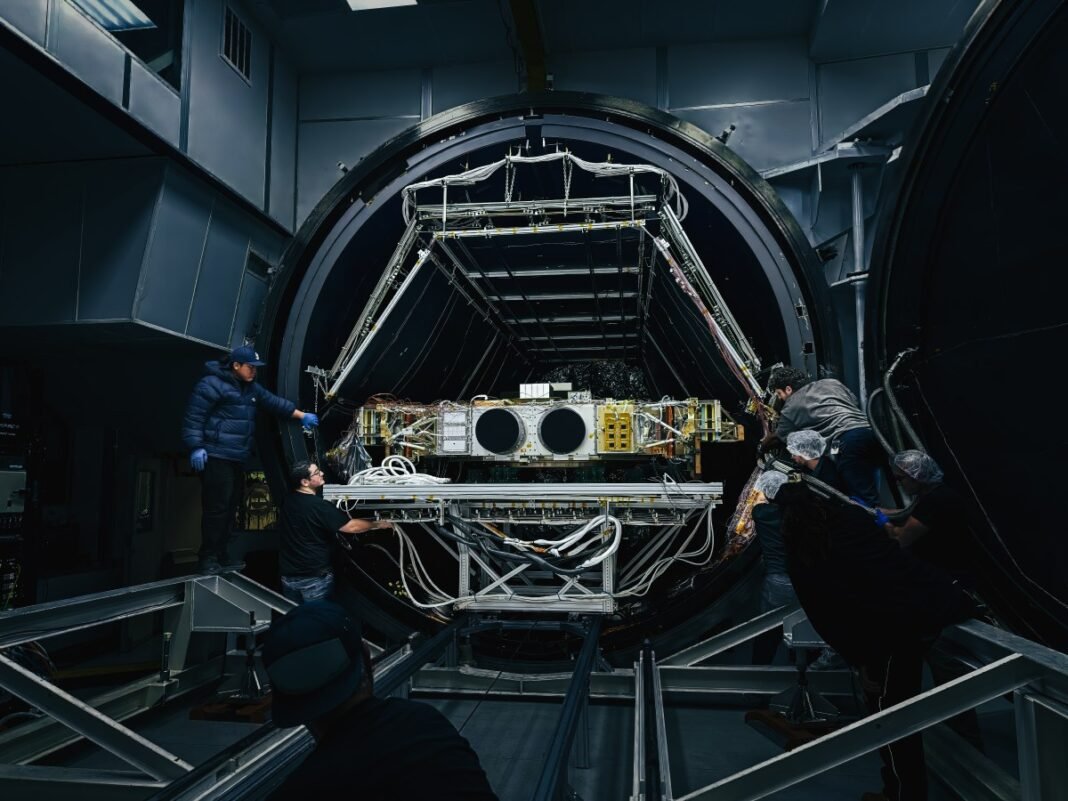
Gravitas: Advancing High-Power Satellites to Enable Orbital Data Centers
Transforming Power Generation in Space
K2 Space, founded by aerospace veterans Karan and Neel Kunjur, is on the verge of launching Gravitas, a satellite designed to push the boundaries of power generation in orbit. This spacecraft, weighing close to two metric tons, will be deployed via a SpaceX Falcon 9 rocket and features solar panels that extend up to 40 meters when fully unfurled. Gravitas serves as a testbed for technologies critical to establishing data centers beyond Earth’s atmosphere.
Setting New Standards for Satellite Power Output
The standout feature of Gravitas is its capacity to produce an impressive 20 kilowatts (kW) of electrical power-an output that supports energy-intensive payloads such as sophisticated sensors, high-bandwidth communication systems, and onboard computing units. To contextualize this achievement: while ViaSat-3 satellites generate over 25 kW and Starlink’s latest V3 satellites deliver around 20 kW each,most operational spacecraft today function with only a few kilowatts.
Enabling Advanced Satellite Capabilities
This ample increase in available power unlocks new possibilities for satellite operations. With enhanced energy reserves,satellites can maintain stronger communication links featuring higher data rates and improved resistance against electronic interference or jamming attempts. Moreover, as hyperscale cloud providers explore space-based computing solutions more aggressively than ever before-driven by latency reduction needs-satellites like Gravitas become vital platforms capable of executing complex processing tasks directly in orbit.
A Complex Mission with Layered Goals
The upcoming flight will carry twelve confidential payload modules from diverse clients including defense organizations alongside an innovative electric propulsion system rated at 20 kW-the most powerful thruster ever tested in space according to company estimates. The mission follows a phased success plan: frist confirming deployment mechanisms and power generation; then activating payload functions while testing the electric thruster; finally attempting orbital altitude adjustments by propelling the satellite thousands of kilometers higher using its advanced propulsion technology.
Tackling Engineering Hurdles Through Iterative Testing
Karan Kunjur highlights the intricate challenges involved in developing such an advanced spacecraft-with roughly 85% of components engineered internally-and acknowledges that initial missions face intense scrutiny from stakeholders demanding flawless execution.the primary objective is extensive data collection during this maiden flight to refine future designs. Over the next two years, K2 plans eleven additional launches combining presentation flights with commercial deployments aimed at scaling their constellation architecture.
Financial Considerations Behind High-Power Satellites
The cost associated with deploying large-scale satellites remains critically important despite technological advances. Even though K2 initially planned on utilizing SpaceX’s Starship vehicle-which promises dramatic reductions in launch expenses-the timeline for Starship becoming fully operational remains uncertain due to ongoing advancement phases.
Currently priced at approximately $7.2 million per Falcon 9 launch under customer agreements (compared with potential $600K costs if Starship achieves routine service), Gravitas itself carries an estimated production cost near $15 million-a competitive figure relative to conventional high-power satellites but offering superior capabilities compared with similarly priced smaller models.
Designing for Next-Generation Heavy-Lift Rockets
Kunjur stresses that his team is proactively crafting designs optimized for forthcoming super-heavy launch vehicles like Starship and Blue Origin’s New Glenn once they enter regular operation cycles. Already visible on their factory floor are plans for an enormous satellite delivering nearly 100 kW-class output-spanning almost the length of a building-signaling ambitions well beyond current industry standards.
The Rising Need For Electrically Robust Orbital Infrastructure
- Commercial Satellite Networks: Expanding constellations such as Amazon LEO and Starlink demand increased onboard power capacities to support enhanced global connectivity services efficiently.
- Defense Applications: The U.S Department of Defense has earmarked investments exceeding $185 billion toward missile defense systems involving thousands of new satellites requiring substantial electrical resources per platform.
- Civilian Cloud Computing: leading hyperscale cloud providers exploring orbital compute solutions rely heavily on high-powered satellites capable not only of relaying but also processing vast volumes of data directly above Earth’s atmosphere.
“Our approach centers on developing all critical components now so we can led when heavy-lift rockets become widely accessible,” explains CEO Karan Kunjur regarding their strategy toward future-proofing ultra-high-power spacecraft manufacturing.”


